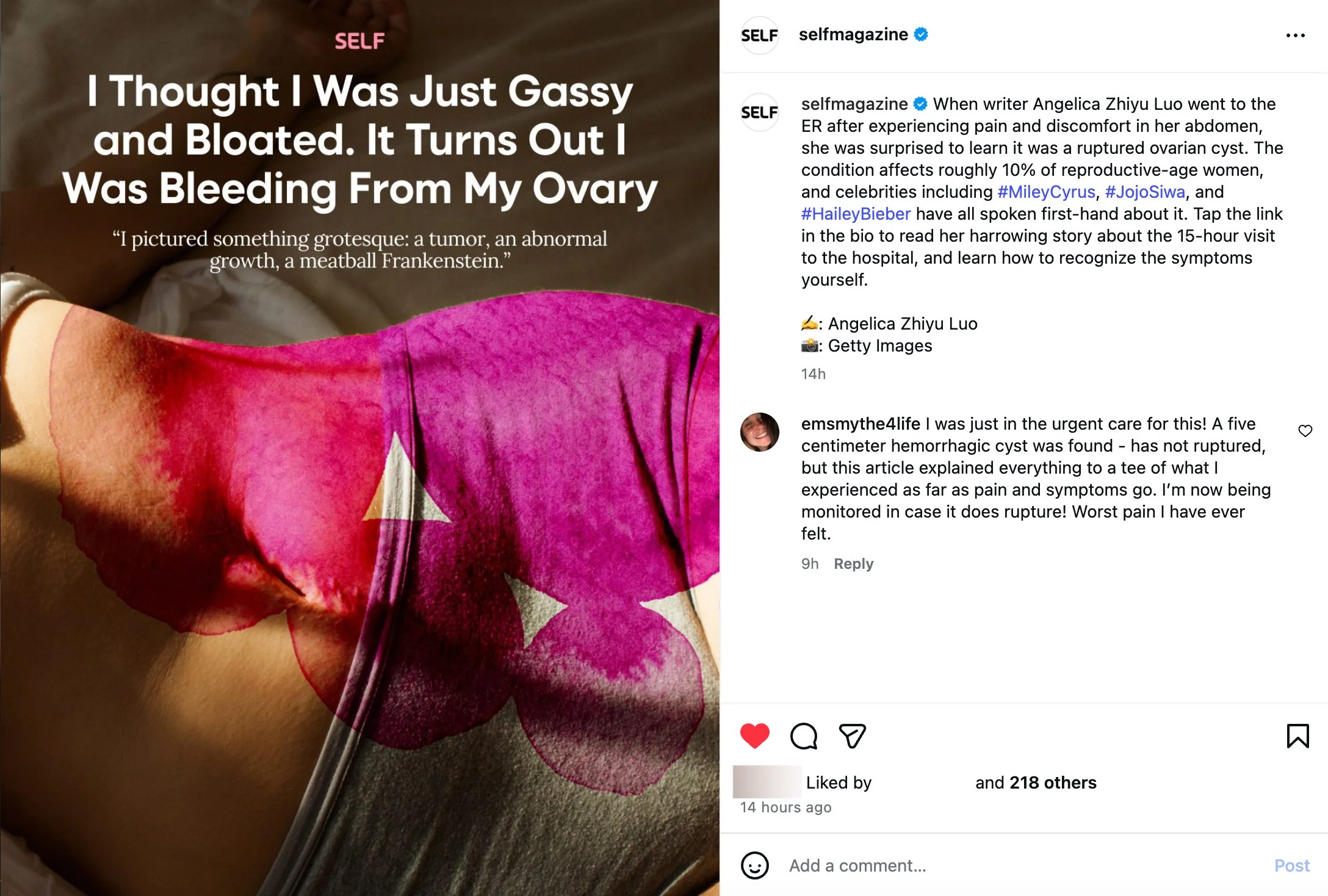
I Thought I Was Just Gassy and Bloated. It Turns Out I Was Bleeding From My Ovary

Collage: Self; Source Images: Yifei Fang/Sophie Mayanne/Getty Images
The time was 11 p.m.
I tossed and turned in discomfort, while trying to fall asleep after intimacy. A sharp pain swirled around my lower belly, but I thought it was only gas from the beans and a beer I had for dinner that night with my boyfriend.
An hour later, my snooze was disrupted by what felt exactly like the beginning of a vasovagal syncope episode, a type of fainting I suffer from during blood draws or sitting up too fast. Vasovagal syncope is common and generally harmless, but it’s an indication that the body is under some sort of stress.
Everything felt all too familiar: the lightheadedness, cold sweats, a violent urge to vomit… But this time, there was no obvious trigger.
I knew immediately something was very wrong, somewhere I couldn’t see or directly feel. My body quickly confirmed my hypothesis, as I fainted again within mere minutes.
Two fainting episodes back-to-back. That had never happened before.
“Call an ambulance,” I told my boyfriend when I regained consciousness. I struggled to even speak, barely coherent after throwing up and with my clammy fingers still clasping onto the trash can rim.
Two EMTs arrived 10 minutes later and swiftly hauled me onto a stretcher. The ambulance roared through empty streets, bypassed every red light, and I burst into tears (of confusion and fear). The medics rolled me into my local ER.
Multiple blood tests and 108 pelvis, transabdominal and transvaginal ultrasound images later, my ER doctor informed me of a possible ovarian cyst rupture.
Immediately, I pictured something grotesque: a tumor, an abnormal growth, a meatball Frankenstein. I was 24 years old and excessively health-conscious; how did I not know this was growing inside me, let alone it had burst?
Turns out, I probably couldn't have known anyway.
Like an erupted, angry pimple
“Ovarian cysts are generally collections of fluid that form like a pocket within the ovary,” Kelsey Kossl, MD, a gynecologic surgeon at NYU Langone Health, tells SELF.
Although sharing the same term “cyst” with Dr. Pimple Popper's gnarly, gushy specialty, ovarian cysts mostly refer to naturally occurring follicles, or, in Dr. Kossl’s words, “little houses for our eggs.”
Every month, our ovaries grow 15 to 20 tiny follicles, one of which becomes dominant and can grow to two or three centimeters as part of its natural role in the menstrual cycle, per Dr. Kossl.
While most ovarian cysts resolve on their own over time, some can persist and can even grow over 10 centimeters, according to Heather Jones, MD, an ob-gyn at NYU Langone.
Once it puffs up, the risk of rupture rises, especially with “any type of events that cause increased intra-abdominal pressure, such as vaginal intercourse or strenuous exercise,” Dr. Jones tells SELF. She also adds that ovarian ruptures can occur in as many as 10% of reproductive-age women like me.
It’s also probably what happened to 33-year-old celebrity Miley Cyrus while hosting a party with Dolly Parton, and to Gen-Z singer-dancer Jojo Siwa.
Looking back, I feel a little silly for mistaking the strong stab to my belly for gastrointestinal irritation. But, to give myself some credit, Dr. Jones confirms that an ovarian rupture can feel like a lot of other things.
“A lot of times you can feel the pelvic pressure,” she says. “You may have some gastrointestinal symptoms as well, such as nausea, vomiting; some people get really hot or flushed.”
In any case, I applaud myself for involving the EMS fast. When I arrived at my local emergency room, my blood pressure had dropped to 70 over 40, and I was immediately hooked to IV bag after bag of Lactated Ringer’s bolus (saline, but better) for hydration.
I even completely lost consciousness due to another episode of syncope, while walking just seven feet from the bathroom to my hospital bed. I almost collapsed on the floor and woke up in the arms of six medical professionals.
Tests later brought in the final verdict: Not only did I have an ovarian cyst, but it was also hemorrhagic (translation: like a little blood pulp). As it burst open, blood flowed into my abdominal space, leading to both the drastic blood pressure drop and organ irritation that felt like bloating.
To ensure my wound was closing, nurses tracked my red blood cell count with hourly tests, while also arranging for a transfusion on standby—just in case the blood loss didn’t contain itself.
But how does a cute little “house for eggs” turn bloody?
“As part of [a follicle’s] resolution process, a little blood vessel can burst and allow the pocket to fill with blood,” explains Dr. Kossl. “That in and of itself, a hemorrhagic cyst, can be really painful.”
And painful it was. The abdominal pain stretched to every limb, radiating to my left shoulder and both legs every time I moved.
Fortunately, back-to-back vital checks proved that the damage had been done and was over with. My cyst had burst and released the fluid “cache.” All I could do then was to wait for my body to absorb the blood and for the wound to heal, somewhat like how you’d treat an erupted, angry pimple.
Repeat ruptures are rare
I was discharged the next evening, even given the green light to proceed with my long-anticipated trip to Hawaii. My primary doctor suggested just two things to keep an eye on: One, I’d be swollen from excess fluid in my abdomen, so I might want to pack a one-piece swimsuit; and two, cut back on extreme hikes.
“Make sure you get rest, heat, and we just wait for that fluid to slowly absorb itself on its own,” says Dr. Jones regarding the recovery process. “[Take] pain medications as needed, and I usually encourage pelvic rest, like limiting going to the gym for a brief time period.”
It took two weeks for the free-flowing fluids in my abdomen to fully absorb. And my doctor was right: The swelling protruded like a massive Thanksgiving dinner, or even a second-trimester pregnancy, tender and pulling on every muscle.
So you can only imagine my relief when Dr. Kossl mentioned that it’s extremely rare for women experience multiple ovarian cyst ruptures.
“The event of a cyst rupture is not going to happen to the majority of women, but it’s also not uncommon,” she told me. “Of all those women out there who get cyst ruptures during their lifetime, it’s such a small portion that experience it multiple times over the span of a few years.”
Unfortunately, when asked about preventative measures, Dr. Kossl says an ovarian cyst “kind of comes out of nowhere,” especially for patients who don’t experience chronic pain or abnormal spotting.
“Even if you were seen and had an exam by your gynecologist, even just one to two months prior, everything totally could have looked well,” she adds.
That said, I will probably be in the clear for another rupture anytime soon, as multiple ruptures are extra rare, and occur mostly in women in their late teens to early 20s, when our ovaries are just really active, according to Dr. Kossl.
“It doesn't really persist to be a lifelong thing for them,” she says. “They just have a few incidents that occur within those younger reproductive years.”
For cases more extreme than mine, Dr. Jones suggests considering birth control pills to “help quiet down the ovaries,” and consuming anti-inflammatory foods to support hormonal balance.
Months later, I’m back to normal. Gymming, living, and, thank goodness, having sex without terror. I’m grateful I trusted my gut when I began experiencing the sudden onset of pain and sought help.
Just remember: Recovery is possible, repeat ruptures are rare, and you’re not alone in mistaking internal bleeding for gas.
Instagram post feature
